
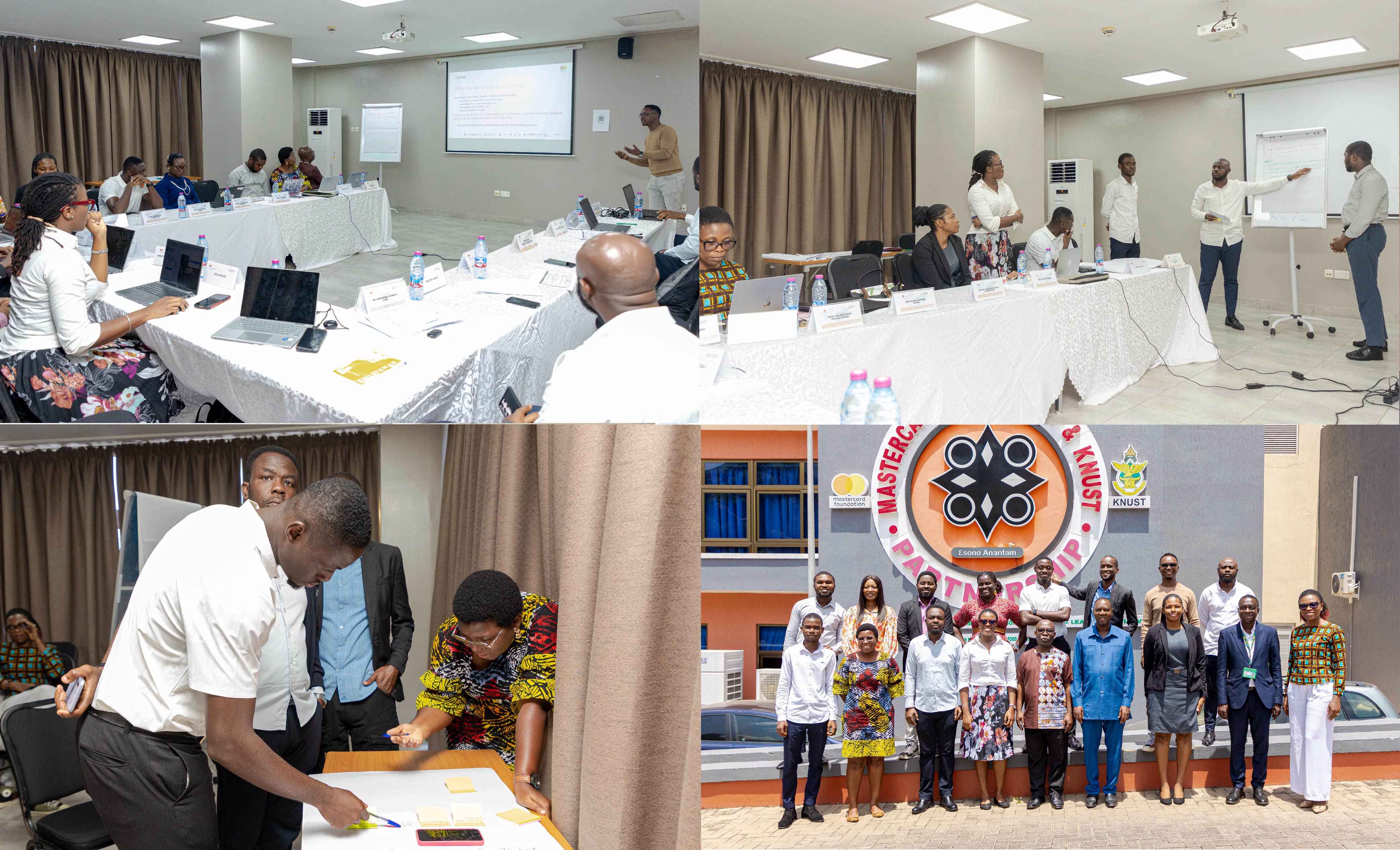
The Africa Health Collaborative at the Kwame Nkrumah University of Science and Technology, Kumasi (KNUST), in partnership with the Mastercard Foundation, has hosted a delegation from its Secretariat Learning Partner for a three-day inception visit aimed at strengthening collaboration and enhancing programme delivery.
The visit is focused on reviewing and refining existing insights by building on prior work, partner reports, and materials generated during the Annual Convening and the Monitoring, Evaluation, Learning and Adaptation (MELA) Network Meeting. It also seeks to deepen the working relationship between the Learning Partner and MELA leads across participating institutions.
Outcomes from the engagement will directly inform the design and implementation of key interventions at the Collaborative level, particularly within the Learning Partnership and Accompaniment workstream, ensuring more adaptive, evidence-driven programme execution.
The Secretariat Learning Partner delegation comprises Dr. Ernest Asamoah, Dr. Jackson Ilangali, Ms. Leila Khalid, Timothy Kinoti, Oluwafisayo Ayodeji, and Richard Oladipo, whose collective expertise is expected to advance learning systems and strengthen impact across the Africa Health Collaborative network.
The Principal Investigator of the Africa Health Collaborative at the Kwame Nkrumah University of Science and Technology, Kumasi (KNUST), Prof. Ellis Owusu-Dabo, underscored the importance of grounding policy and programme development in lived experience and evidence-driven learning.
He noted that the Collaborative is reaching a critical stage where insights generated from implementation must begin to shape policy direction, emphasizing that those directly engaged in programme delivery are best positioned to inform meaningful change.
Describing the process as “meta,” Prof. Owusu-Dabo explained that the initiative goes beyond conventional monitoring and evaluation or documenting learning experiences. Instead, it focuses on systematically integrating these insights into adaptive strategies that inform future programming.
He further highlighted the deliberate strengthening of the research component within the Collaborative, aimed at ensuring that all learning and adaptation processes are firmly anchored in evidence.
According to him, this involves leveraging diverse knowledge outputs from research studies and programme data to documentary storytelling to assess impact, refine approaches, and continuously improve outcomes.
“This approach allows us to not only understand what we are doing,” he noted, “but to critically examine how we can do it better, ensuring that every intervention is informed by credible evidence and responsive to the realities on the ground.”
The three-day inception visit was structured around a series of focused engagements designed to strengthen evidence generation, learning systems, and the development of a robust Monitoring and Evaluation, Learning and Adaptation (MELA) partnership within the Africa Health Collaborative. Activities included one-on-one interviews, small group working sessions, and inquiry-based discussions with Pillar Leads, alongside technical MELA sessions that explored the contribution and practical use of data and insights across the Collaborative.
The visit concluded with site engagements, including visits to Seventh-day Adventist Hospital Asamang and the KNUST University Hospital.
At the SDA Hospital in Asamang, Peggy Nketiah, a nutritionist and alumna of the 2024 Palliative Care Modules I and II, shared how the training influenced both institutional practice and personal experience.
She recounted that prior to participating in the programme, her team had initiated plans to establish a palliative care service but had not operationalised a clinic due to the assumption that a dedicated ward and significant resources were required.
“Before the training, we believed we needed a specialised ward to begin,” she explained. “However, during the sessions, we were guided to understand that palliative care can be effectively delivered without a dedicated ward or extensive funding. That shifted our entire perspective.”
She noted that the training, delivered in partnership with the Mastercard Foundation, empowered her team to move forward with implementation using available resources, accelerating the delivery of care to patients in need.
Beyond the institutional impact, Ms. Nketiah highlighted the personal significance of the training. Shortly after completing the programme, she encountered a situation involving a close family member requiring palliative care.
“It has really helped me, beyond my professional role,” she said. “When a relative of mine faced a similar condition, the family did not fully understand what she was going through. But because of the training, I was able to recognize the situation and provide the necessary care and support.”
During the inception visit, the delegation also toured the KNUST University Hospital, where staff demonstrated how training under the Africa Health Collaborative, in partnership with the Mastercard Foundation, is driving tangible improvements in healthcare delivery.
Health professionals who participated in the Quality Improvement (QI) training delivered in collaboration with the University of Toronto and the School of Public Health at Kwame Nkrumah University of Science and Technology shared how the programme equipped them with practical tools to assess and address service gaps.
Following the training, the team conducted a patient satisfaction survey which revealed strong overall satisfaction but highlighted key challenges in communication, empathy, and responsiveness. In response, they implemented a targeted QI project focused on improving patient-centred communication at the Outpatient Department.
Over 300 staff across clinical and non-clinical roles have since been trained in effective communication, supported by initiatives such as the “Hello, My Name Is” campaign, continuous refresher sessions, and digital awareness tools.
The hospital has also strengthened its internal systems by reactivating its Quality Assurance structures and embedding communication practices into staff orientation and daily operations.
The team noted that the initiative is already fostering a culture of improved patient engagement and accountability, demonstrating how evidence-based training and adaptive learning can lead to sustainable improvements in healthcare quality.
| Story: Emmanuel Offei |


